 2 hours ago
1
2 hours ago
1
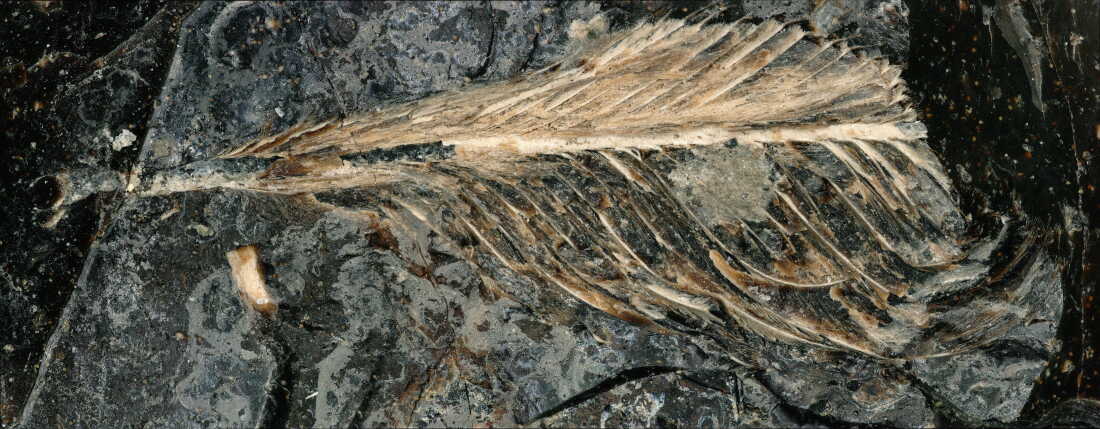
This fossilized feather dates back 66 million years to the late Cretaceous. "It is, without a doubt, the best feather we've ever found from the age of dinosaurs," says Jingmai O'Connor, an associate curator at the Field Museum of Natural History.
Nate Carroll
hide caption
toggle caption
Nate Carroll
Paleontology can be quite physical.
In 2016, David DeMar was doing field work in the rocky badlands of Montana in what's known as the Hell Creek Formation.

"We all get down on our hands and knees," he recalls. "And I start crawling up the hill and I noticed this little dark, round object on the ground. It was kind of odd."
DeMar, a lab manager at the Burke Museum in Seattle, picked up the cherry-sized fossil.
"I start looking at the surface of it," he says. "And then I rolled it over and I was like, 'You got to be kidding me.'"
Embedded in a small crack on the surface was a tiny fossilized branching structure. As it turned out, this was the first fossilized feather from this part of the world.
In addition, "it is, without a doubt, the best feather we've ever found from the age of dinosaurs," says Jingmai O'Connor, a bird expert and an associate curator of fossil reptiles at the Field Museum of Natural History in Chicago.

The researchers say the plume, which they describe in the journal Current Biology, is part of a fossil assortment that may reveal part of a late Cretaceous food web from some 66 million years ago. And they speculate it could help explain why, around that time, many types of ancient birds died out alongside the dinosaurs after a giant asteroid collided with the Earth — while others survived to give rise to the birds we know today.
Excremental progress
After first spotting the round nodule, DeMar quickly radioed his colleagues. At first, no one responded.

"They probably thought I was kidding," he says.
"But I got back on the walkie about five minutes later. I was like, 'No, hey guys, I think I found a bird feather.'"
Subsequent analysis confirmed DeMar's conclusion. The feather dates back to the late Cretaceous, right before the great extinction event that wiped out the dinosaurs and a large swath of other species.

When O'Connor joined the project, very little was known about the feather, except that it looked quite modern. "My goal was to try to figure out what animal this feather belonged to," she says, "and then in the grand scheme of evolution to try to say, 'Well, what can this exceptional feather tell us?'"
The round object that the feather was sitting in turned out to be a chunk of coprolite — that is, fossilized feces — produced by a large meat-eating dinosaur. "So I would argue that Tyrannosaurus rex or Nanotyrannus are the more likely candidates," says O'Connor. (This coprolite had actually broken off from a few larger, softball-sized pieces where additional clues may later be found.)
The team CT-scanned the small coprolite and found it contained still other feathers, a couple of bone fragments, and two tiny fish scales. After studying the feathers and bones, O'Connor concluded they likely came from the same animal adapted to life in the water.
She believes it was an ancient aquatic, swimming bird, "kind of like a loon or a grebe," she says. "They're foot-propelled divers."
"It's certainly impressive that this amazing feather morphology could be detected in dinosaur poop," says Richard Prum, an ornithologist at Yale University who didn't contribute to the research. "That is remarkable, unexpected. There's nothing of that age that's so beautifully preserved, [including] evidence of individual cells."
The researchers argue that the fish scales also preserved in that coprolite might have been remnants of the ancient bird's last supper before it too became a meal for a predator like T. rex — and that that animal later defecated out the fragments that would be discovered by DeMar roughly 66 million years later.
A Cretaceous turd-ucken
This bird was one of many types of birds that went extinct with the dinosaurs, when the Chicxulub asteroid smashed into the planet and sent ash and soot into the air, clouding the skies and causing a dramatic planet-wide cooling.
"You have all these birds during the Cretaceous," says O'Connor. "And only one group of birds survives when the asteroid impact happens." That group was the one that gave rise to modern birds.
Researchers have wanted to know what provided the surviving birds with the edge they needed to make it through the drop in global temperature. O'Connor thinks it may have to do with the fact that they were better insulated. Building on her previous work, she noticed that some of the fossilized body feathers inside the coprolite from the ancient bird (whose relatives ultimately died out) appeared to lack the insulation of their modern counterparts.
"How do they stay warm when it gets cold, when this [asteroid] impact winter happens?," she says. O'Connor isn't arguing that plumage differences are the sole reason behind the extinction of these birds. "I'm saying it's a contributing factor."
Not all researchers agree with the conclusion, however. "I think it's a stretch to explain the survivorship of some [species] and the extinction of others from that evidence," says Julia Clarke, an evolutionary biologist at UT Austin who wasn't involved in the study. "The fragments themselves are incomplete."
Still, she's taken by the snapshot of a food chain apparently captured by this piece of poo. "A dinosaur ate an aquatic bird that ate a particular type of fish," she muses. "Almost like they've discovered a Cretaceous turducken."
What O'Connor believes they've discovered is a new way of gaining access to crucially important specimens since telltale features don't usually preserve very well.
"Now that we know that coprolites of some carnivorous dinosaurs can preserve soft tissues," she says, "we now have this whole potential to find fossilized not just feathers, but fur and other soft-tissue structures."
O'Connor considers the work worthwhile. Understanding past extinctions says something about the current extinction crisis — and who may survive and who may not.