 3 months ago
105
3 months ago
105

The eye and the mind's eye: New evidence finds that sight and imagination rely on the same neurons and use the same neural code. Marco Bottigelli/Getty Images hide caption
toggle caption
Marco Bottigelli/Getty Images
It's often called the mind's eye.
"I can look at an object in the world around me, but I can also close my eyes and imagine the object," says Varun Wadia, a brain scientist at Cedars-Sinai Medical Center and the California Institute of Technology.
That sort of visual imagination, Wadia says, is what allows most people to conjure the face of a loved one or navigate to work using a mental map.

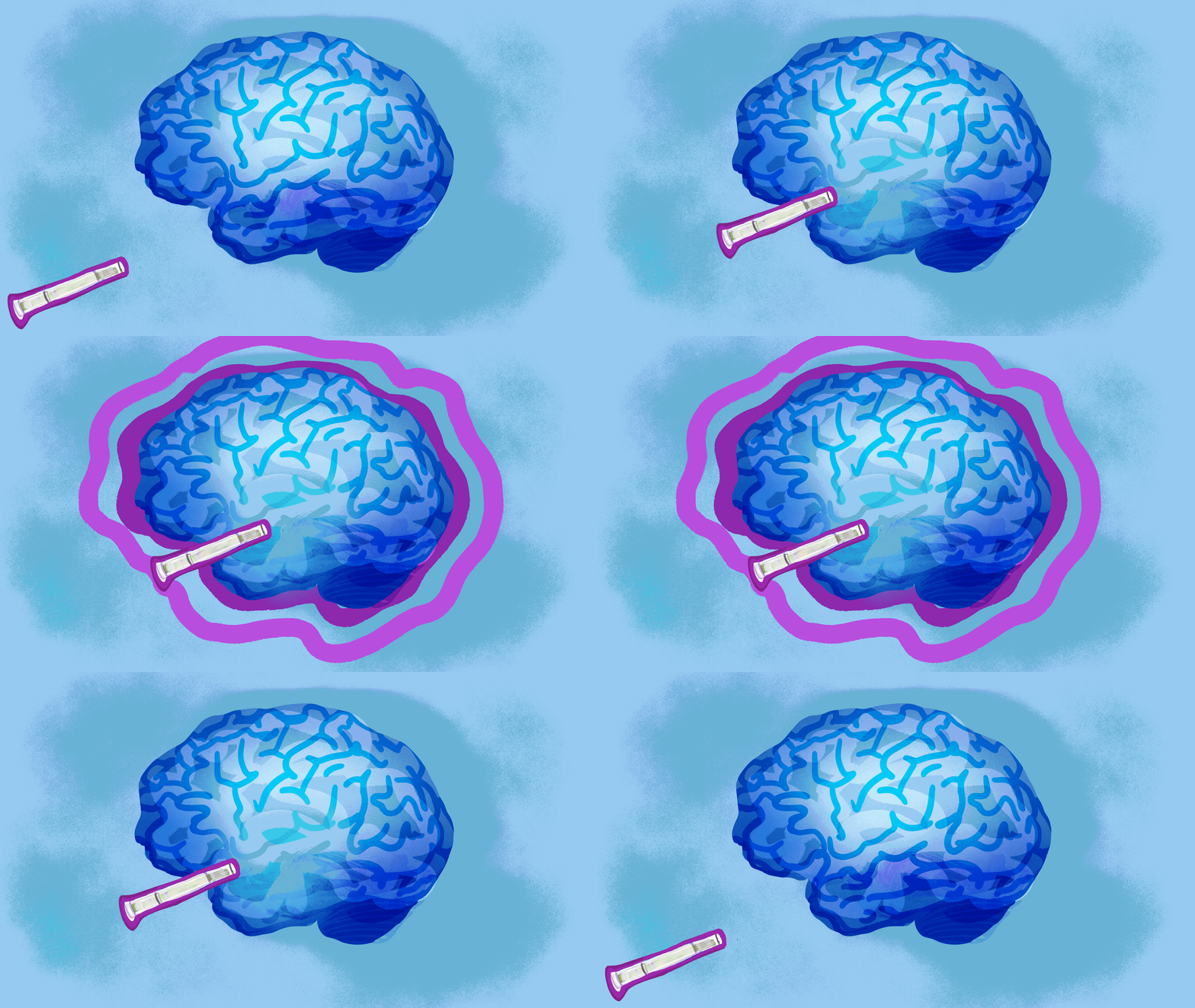
But its neural underpinnings were a mystery until Wadia and a team reported in the journal Science that imagined and perceived objects appear to activate the same neurons and use the same neural code.
"This has not been demonstrated before at the neural level," says Kalanit Grill-Spector, a psychology professor at Stanford University's Wu Tsai Neurosciences Institute, who was not involved in the research.
With these insights, she says, scientists are one step closer to building computer models that can simulate vision as well as vision disorders like macular degeneration. These models, in turn, could help researchers develop prosthetic devices to restore sight.
The research also helps explain how the brain uses imagination to augment visual information, says Thomas Naselaris, a neuroscientist at the University of Minnesota.

"Objects are three-dimensional. They present themselves to us one side at a time, and yet we intuitively seem to be able to model the parts of the object we don't see," he says.
So the brain imagines a bumper on the back of a car, even if it's out of sight.

Visual imagination also allows people to assemble familiar objects into unfamiliar configurations, Naselaris says, "like a horse with a horn: a unicorn."
Watching individual neurons
The new findings came from a study of 16 patients with epilepsy. All were in the hospital and already had electrodes in their brains so doctors could find the source of their seizures.
That allowed Wadia's team to monitor the activity of more than 700 individual neurons in each participant as they watched a computer screen.

In the first part of the experiment, participants saw hundreds of images. These came from broad categories, including faces, animals, plants and words. The images also included small objects like sunglasses and water bottles.
The team focused on the activity of neurons in the ventral temporal cortex, which is involved in recognizing objects. They recorded which neurons fired in response to each image. They also noted how many times each neuron fired, which let the team decipher the code these cells used to convey information about an image.

In the second part of the experiment, Wadia had each participant close their eyes and imagine one of the objects they had seen. Meanwhile, the team monitored the same neurons that had become active when the individual saw the item.
"About 40% of those neurons reactivated when you were imagining the object," Wadia says, "and they reactivated with roughly equal strength."

The overlap was so great that the team could tell whether the patient was imagining a specific object, like an airplane, says Ueli Rutishauser, whose lab at Cedars-Sinai carried out much of the work.
The activation pattern even revealed details about the object, "like it's so big and it's at this angle, and it's outside or inside," says Rutishauser, who also is on the faculty at Caltech.
New evidence for an old idea
The result supports earlier studies that used brain imaging to find evidence that the same neural circuits are involved in both seeing and imagining. But technologies like functional MRI can't show what individual neurons are doing.
It also builds on research by Doris Tsao, a University of California, Berkeley professor and an author of the new study, who showed in previous work how the visual system of monkeys is able to recognize faces and other objects.

But the research doesn't explain the brains of people with a rare condition called aphantasia, which leaves them unable to voluntarily summon mental images.
Rutishauser learned about the condition when he gave a talk about his research on imagination at a scientific meeting.
"Afterwards, a very prominent and successful scientist came up to me and said, 'I don't know what you're talking about. I don't see anything when I close my eyes.'"
Scientists believe people with aphantasia use words or concepts to recall what they've seen. But it will take studies of their neurons to understand how their brains accomplish this.