 3 months ago
59
3 months ago
59
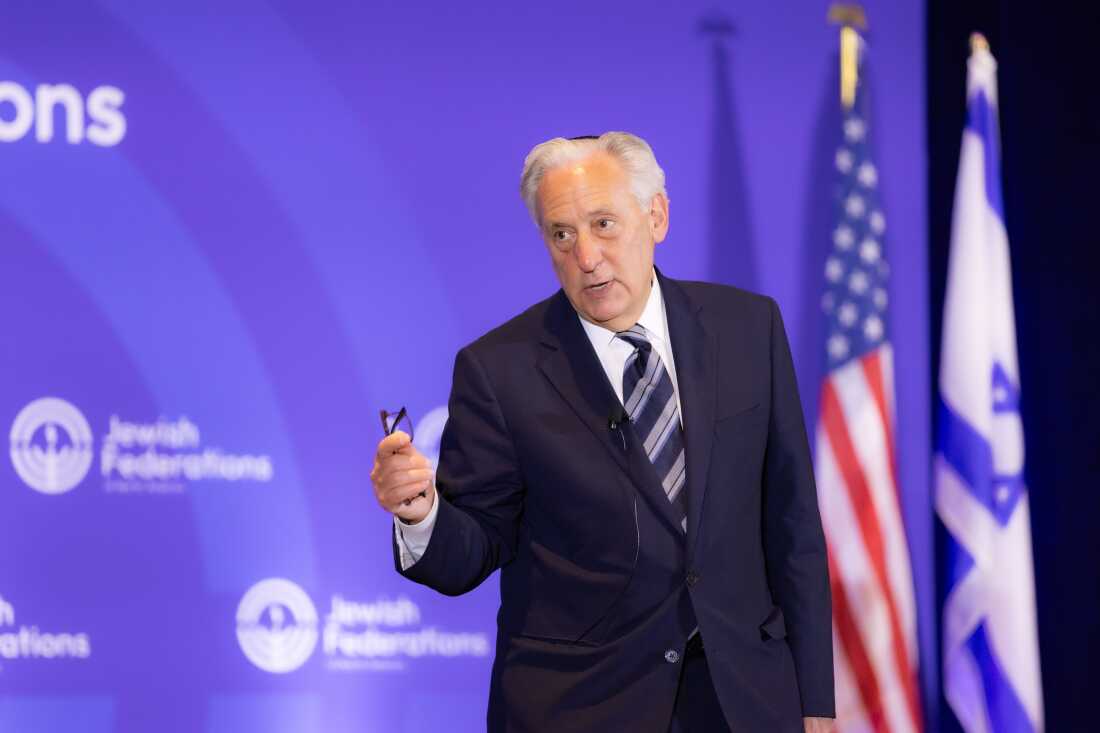
Eric Fingerhut, the president and CEO of the Jewish Federations of North America, speaks at an event in D.C. on May 18, 2026. JFNA organized an advocacy fly-in of more than 400 Jewish leaders to Capitol Hill to urge lawmakers to support more funding for the Nonprofit Security Grant Program, which offers funding to strengthen security at houses of worship. Photo courtesy of the Jewish Federations of North America hide caption
toggle caption
Photo courtesy of the Jewish Federations of North America
At a recent Shabbat service in West Bloomfield, Mich., Rabbi Jen Lader shared plans to lobby Congress to pour more funding into a federal program that strengthens security at houses of worship.
"We are not asking Congress to just protect Jews – we are asking Congress to protect every community of Americans that gathers to pray. And we are asking with the full weight of what we have just lived through behind us," she said, referencing the March attack on her congregation of Temple Israel.
The fact that no one was killed other than the attacker is a credit, Lader said, to their security personnel and rigorous staff training.
"If we had not had those resources and that funding, this would have been a really different story," she told NPR. "And we cannot allow a single other community to experience something as horrific as we've experienced, knowing that there were resources that could have gone into saving lives."
Lader and over 400 other Jewish leaders travelled to D.C. this week to push for an increase in funding for the Nonprofit Security Grant Program (NSGP), which awards funding to nonprofits to enhance security – from installing door locks and security cameras to erecting bollards to prevent vehicles from crashing into buildings.
"It's tragic that we have to be thinking about this in the same way that TSA protects airports and businesses protect their premises, but we have to," said Eric Fingerhut, president and CEO of the Jewish Federations of North America, the group leading the lobbying effort this week.
The advocacy push on Capitol Hill happened to come just one day after two teenagers attacked a San Diego mosque, killing three men and themselves.
"It's one of those moments where you think, is this going to happen to us? Is it a matter of when or if?" said Fadi Hammami, co-president of the Islamic Association of Greater Hartford. "Are we prepared?"

Two women cry as they leave a reunification center following the shooting at the Islamic Center of San Diego in southern California, on May 18, 2026. A shooting at the largest mosque complex in San Diego killed three people, with two suspected teenage gunmen later found dead in a car from self-inflicted gunshot wounds, police said. ZOE MEYERS/AFP via Getty Images/AFP hide caption
toggle caption
ZOE MEYERS/AFP via Getty Images/AFP
Longstanding program to secure houses of worship
Hammami said the Islamic Association of Greater Hartford started applying in 2019 for the NSGP, which is administered by FEMA under the Department of Homeland Security. Nonprofits apply via State Administrative Agencies, providing materials like vulnerability assessments, budget estimates and proposed expenditures.
Hammami said they were approved for fifty thousand dollars in 2021. They used the funds to strengthen doors and buy security cameras and alarms. But despite potential further enhancements, they've since stopped applying.
"While the merits of the program are great, the administration part has a lot to be desired," he told NPR, pointing to the program's reimbursement structure.
Nonprofits must wait for approval before beginning any security enhancements, and must come up with the funds on the front end to later be reimbursed. Some states may offer a cash advance option, but FEMA's federal process is reimbursement-based.
"Luckily, we are one of the bigger associations and we had some reserves that we applied towards that before we could get reimbursed," Hammami said. "But a lot of our smaller Islamic centers do not have that amount of cash."
Shane Dennis, the community security director for the Jewish Federation of Greater Ann Arbor, said this is a common challenge. In his role, he helps organizations navigate the NSGP application and provides security assessments.
"We start from the outside, whether there's fencing or gates in the parking lot, how many entrances it has, lighting, cameras, access," he explained. "And inside, looking for door locks, locations to secure yourself within a building, blind spots for cameras, things of that nature."
Under the program, individual houses of worship can request up to $200,000. Nonprofits with multiple sites can submit for up to three sites for a maximum of $600,000 per state. But Dennis said often, nonprofits will apply for less.
"There's low hanging fruit," he said. "For example, good door locks can be $40-50 a door, or putting stickers on doors so you can share a map of the building with law enforcement – so if you're locked down, you can tell the police 'I'm by door five.'"
He said the administrative process can be 'cumbersome' and 'frustrating' because of a long list of forms to coordinate with state agencies and "many layers of follow up." He said the whole endeavor can sometimes take years from start to finish, a process made lengthier by recent DHS shutdowns.
Jerry Sorokin, executive director of Beth Israel Congregation in Ann Arbor, Mich., applied in 2024 to install bollards outside the school entrance.
"The problem is that you cannot begin the project until the grant has been approved, and so everything got put on hold while we waited for a response from the government," he said. "When that response ended up being 'no', we were months behind where we wanted to be."
Fast forward to this March, when Sorokin watched the news of a truck ramming into a synagogue preschool just forty miles away.
"When Temple Israel was attacked, it showed me that, in fact, this could happen to us, that we weren't exaggerating our concerns," he said, adding he immediately went out to rent bollards.
"It's a challenge. We have to put other priorities on hold in order to focus on upgrading security needs in the building," he said. "But it doesn't matter how well heated or cooled your building is – if people don't feel comfortable being there because they're scared, that's not acceptable."

Rep. Josh Gottheimer, D-N.Y., seen here during a hearing on June 24, 2025, has been hearing from religious leaders in his district with concerns about the safety of their houses of worship. Chip Somodevilla/Getty Images/Getty Images North America hide caption
toggle caption
Chip Somodevilla/Getty Images/Getty Images North America
The view from Capitol Hill
Rep. Josh Gottheimer, D-N.J., is part of a bipartisan contingent of lawmakers who support increasing NSGP funding.
"I've got religious leaders constantly calling me and saying, 'I'm scared. My parishioners are scared,'" he told NPR. "We are meeting fewer than half of the requests from synagogues and churches and mosques around the country, so we need more resources."
For fiscal year 2024, roughly 33 percent of applications were awarded funding. Over 12,000 applications were received; of those, roughly 4,000 were awarded with funds from the NSGP and a separate, related security fund.
Funding for NSGP has grown significantly since its launch in 2005. In FY 2025, NSGP's congressional appropriations were $274.5 million. That money was delayed heading out the door because of an extended shutdown of DHS, which ended last month. The FY 2025 awards are expected to be announced by FEMA in June.
"We are working diligently and as fast as we can to get the money out of the door," said Victoria Barton, Associate Administrator for the Office of External Affairs at FEMA. "If there hadn't been a shutdown, there wouldn't be this delay."
Lawmakers have been pushing to increase funding and sent a letter in January to then-DHS Secretary Kristi Noem with concerns about compliance requirements. Applicants expressed concern and confusion about whether NSGP application materials indicated grants could be contingent on cooperating with federal immigration enforcement.
"We were hearing from houses of worship that were concerned about applying, if suddenly your temple is not a safe space from an ICE raid," Gottheimer said.
New guidance to clarify requirements is expected from the department, which is under new leadership.
Meanwhile, a bill proposed Tuesday seeks not only to boost congressional funding for the program to one billion dollars, but would increase resources for state-level grant administrations and require reimbursement processing to be released within 90 days of congressional appropriations. It would also ease limitations on hiring security personnel.
The original design of the program was to harden physical defenses, not pay for security personnel. In 2019, NSGP expanded it to allow nonprofits to use funds for off-duty law enforcement as contracted personnel. Nonprofits cannot currently use funding to hire public safety officers as direct employees.
Advocates say it's time to change that.
"The security guards at Temple Israel and the Islamic Center in San Diego were the difference between saving lives and not," said Fingerhut of JFNA. "Security guards who work for the institution are so much more effective – they know the buildings, the families, the employees. They know when something is out of sorts."
Islamic organization calls for briefing with administration
In the wake of the attack Monday, the Council on American-Islamic Relations (CAIR) sent a letter to DHS Secretary Markwayne Mullin, expressing concerns that Islamic centers were blocked from access to NSGP funds under prior DHS leadership.
The letter calls on DHS to host a briefing for American Muslim leaders on ensuring equal access to the NSGP and to instruct FEMA to remove any conditions on the program that restrict free speech.
"Under prior administrations, CAIR worked with FEMA and DHS to issue guidance, clarifying to the Muslim community that applying to this grant program would not result in any hostile investigations," said Robert McCaw, CAIR's government affairs director. "I don't think that guarantee exists under the Trump administration."
FEMA told NPR that DHS has not blocked NSGP funds to Muslim groups and encourages all eligible entities to apply for funding.
"Under President Trump, the Department of Homeland Security is committed to protecting all Americans, no matter their faith, from terrorism and targeted violence," FEMA said in a statement to NPR.
McCaw said CAIR itself has benefitted from NSGP funding in the past to harden its headquarters and echoes calls from other religious institutions to call for funds to increase, pending confirmation from the administration of equal access to funds.