 3 months ago
79
3 months ago
79
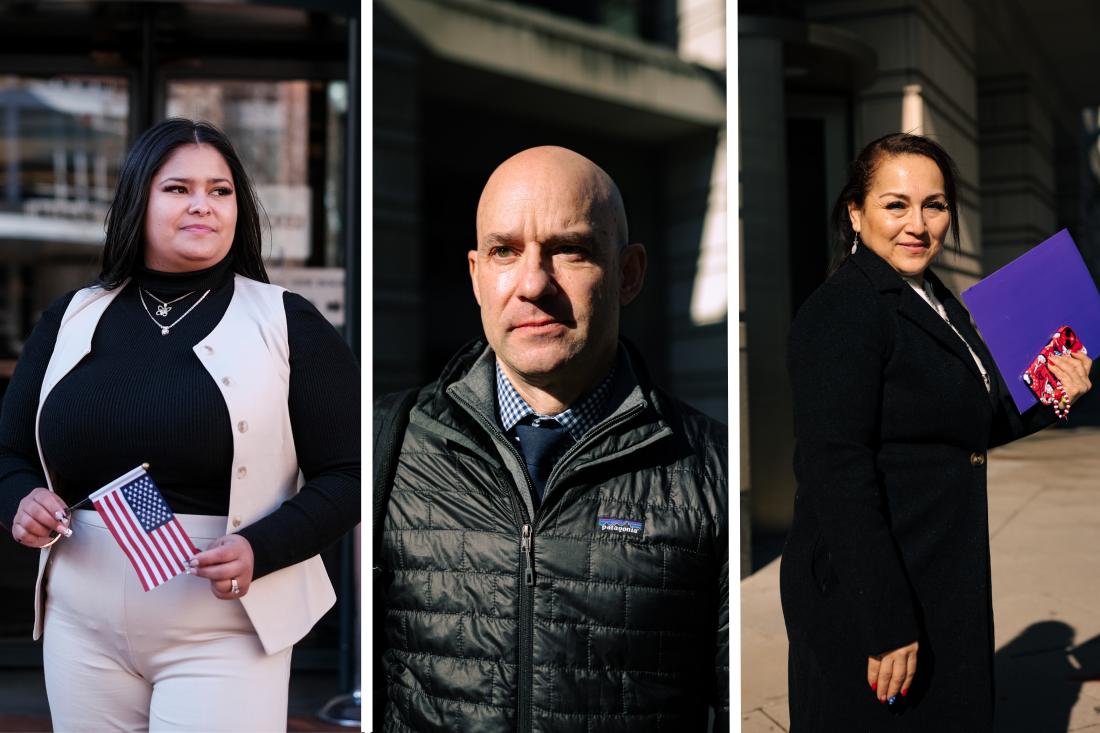
Ashely Lezama (left), of Honduras, stands outside after her first naturalization ceremony at the Albert V. Bryan Federal Courthouse in Alexandria, Va. David Diemert, of Canada, and Zaida Meza, of Guatemala, stand outside after their naturalization ceremony at the E. Barrett Prettyman United States Court House in Washington, D.C. Michael McCoy and Maansi Srivastava for NPR hide caption
toggle caption
Michael McCoy and Maansi Srivastava for NPR
On a recent Tuesday in January, Florencia Paz, an immigrant from Italy and Argentina, joined the line to enter the U.S. District Court in the District of Columbia. She pushed a stroller with her sleeping baby while her husband, a U.S. citizen, quieted their crying toddler.
It was biting cold outside, but Paz said all she felt was excitement and anticipation. Two hours later, she walked out of the courthouse an American citizen, having taken her naturalization oath alongside 103 others from 40 different countries.
Paz said that, after 13 years living in the United States, becoming a citizen was both joyful and a profound relief.

Florencia Paz holds her son after her naturalization ceremony at the E. Barrett Prettyman United States Court House in Washington, D.C., on Jan. 13. Maansi Srivastava for NPR hide caption
toggle caption
Maansi Srivastava for NPR
"I came here to this country by myself, and I became an American in my mind and my heart," Paz said. "I'm not an American by birth in the sense I have not grown up in this culture. But I realize that my path and my route is common to a lot of Americans."

NPR attended three naturalization ceremonies across Washington, D.C. and northern Virginia in January and spoke with more than a dozen naturalized citizens and their families.
The ceremonies were largely celebratory experiences. But they took place against the backdrop of a year of unexpected hurdles and changes to the naturalization process in America.
Among those, U.S. Citizenship and Immigration Services (USCIS) paused the processing of existing immigration applications, including naturalizations, for immigrants from 39 countries who now have travel restrictions to come to the U.S.
"One thing we're finding is that because the journey to citizenship is slower now than it has been in the past, that there are fewer people making it here today," said Barbara Zia. She attended the ceremony in D.C. to register the new citizens to vote on behalf of the League of Women Voters of the District of Columbia. She said usually 125 people are naturalized at that court each time, higher than the 104 at January's ceremony. The ceremony for February is already cancelled.
USCIS Spokesman Matthew Tragesser said the agency "will not take shortcuts in the adjudications process," when asked about the lower number of people getting naturalized in D.C., and the cancellation of a ceremony next month.

'The beginning of the chapter'
For some participating in naturalization ceremonies, the celebrations have been decades in the making; for others, the process began less than a year ago. Some wanted to cement their sense of belonging in America, others desired an added level of safety, or saw it as the next natural step in their lives.
"People have access to better jobs, opportunities, home ownership, they can run for office if they so choose; so there's a lot of benefits," said Nicole Melaku, executive director of the National Partnership for New Americans, an immigrant advocacy group. "For the larger community, it is an ultimate act of inclusion."

Top: Participants wait in line for the first naturalization ceremony of 2026 at the Albert V. Bryan Federal Courthouse in Alexandria, Va. on Jan. 15. Bottom: People awaiting their naturalization ceremony, alongside others summoned to court, stand outside of the E. Barrett Prettyman United States Court House in Washington, D.C., on Jan. 13. Michael McCoy and Maansi Srivastava for NPR hide caption
toggle caption
Michael McCoy and Maansi Srivastava for NPR
In fiscal year 2024, USCIS naturalized more than 818,000 new citizens. Data from fiscal year 2025 has not yet been published by USCIS. Preliminary data from the agency for the first six months of the year showed about 517,000 people applying for naturalization, in line with the prior year — but anecdotal evidence from Zia and others suggest that approved applications could be lower than they have been in the past.
At a morning ceremony in Alexandria, Va., 46 soon-to-be citizens waited in the standing-room-only courtroom, holding mini-American flags and pamphlets titled "Congratulations on Becoming a U.S. Citizen."
"The number of countries represented here today both reflects and further contributes to the rich diversity of the American people," said Judge John F. Anderson, who presided over the ceremony. "As you remember your heritage, share it with your new citizens."
Immigrants getting their citizenship in the broader Washington, D.C., area hailed from across the globe, from El Salvador to Ukraine and India.

Ashley Lezama (right), of Honduras, stands with her husband, Nick Moreno, of Bolivia following her naturalization ceremony in Alexandria, Va. Michael A. McCoy for NPR hide caption
toggle caption
Michael A. McCoy for NPR
"It's some mixture of emotions only because it seems like it's impossible," said Ashley Lezama Moreno, of Honduras. "You know, finally able to cross that finish line. And it just feels amazing. New opportunities, the beginning of the chapter."
An increasingly challenging process
The Trump administration has taken steps to make it more difficult to seek citizenship as the president seeks to limit legal migration to the United States.
Anderson, the judge in Alexandria, invited each new citizen to stand up and say their country of origin. A man in the first row of the courtroom stood up and said "Brazil," another said "Egypt." Two women stood in turn and said "Guatemala," then "Nepal." These are all countries on the new immigrant visa ban list announced earlier this month.

Zaida Meza, of Guatemala, has lived in the United States for 21 years, and applied to naturalize a year-and-a-half ago. She saved up money for years to afford a lawyer to guide her through the process. Her citizenship would likely have stalled indefinitely if she hadn't been approved last year, before the new immigrant visa bans.
"I love this country and I want to vote in the federal elections," Meza said. "I've been working so hard trying to get my legal papers … I feel so blessed in America."

Zaida Meza, of Guatemala, applied to naturalize a year and a half ago after living in the U.S. for 21 years. Maansi Srivastava for NPR hide caption
toggle caption
Maansi Srivastava for NPR
USCIS unveiled a longer, tougher citizenship test in October. It has also moved forward with a rule that would allow officers to consider an immigrant's legal use of public benefits, such as food stamps and healthcare, as a reason to deny status.
In December, the Trump administration also halted processing green card and citizenship applications from nationals of 39 countries with travel restrictions to the U.S. In January, the list was expanded to halt processing immigrant visas indefinitely for 75 additional countries.
The Trump administration has also renewed focus on denaturalization, or revoking citizenship — a process scantly used in the past.

"For years, the Biden administration prioritized rubber-stamping naturalization applications with minimal vetting," said Tragesser, the USCIS spokesperson, adding that the agency plans "rigorous screening and vetting processes across the country."
Ceremonies disrupted

Cori Alonso-Yoder is the director of the Immigration Clinic at the University of Maryland Francis King Carey School of Law. Maansi Srivastava for NPR hide caption
toggle caption
Maansi Srivastava for NPR
There's also been numerous disruptions to regularly scheduled ceremonies.
From October to mid-November, naturalization ceremonies across the country were cancelled due to the government shutdown. Numerous other ceremonies have been cancelled, often at the last minute and without explanation, leaving immigrants in limbo as they await the last step of their naturalization process.
Karim Hamouda, from Egypt, was naturalized in D.C. last week after he was originally scheduled for a ceremony in October. It was cancelled because of the government shutdown and rescheduled to Fairfax County, Va. His Fairfax ceremony also got cancelled; Hamouda says he wasn't given a reason.
"I'm lucky that I had my oath," Hamouda said after his ceremony in January.

Cori Alonso-Yoder, director of the Immigration Clinic at the University of Maryland Francis King Carey School of Law attended the naturalization ceremony in D.C. with one of her clients. The client was "exceptionally nervous" about being arrested even during her citizenship interview, bringing someone with them as support, she said.
"There was a lot of anxiety to get to the place of actually becoming a naturalized citizen today," she said.
Still, she says, the ceremonies serve as evidence that thousands still want to become Americans and participate in the U.S. civic process.
"At its core, citizenship is continuing to move forward and naturalization processes are continuing," Alonso-Yoder said. "The people that we've seen today are truly committed and are taking the steps forward to make that happen."

David Diemert, of Canada, applied to naturalize in March last year after living in the U.S. since 2001. Maansi Srivastava for NPR hide caption
toggle caption
Maansi Srivastava for NPR
David Diemert from Canada has lived in the U.S. since 2001, but applied to naturalize in March last year. He said that naturalizing allows him to leave behind much anxiety and uncertainty to truly build a future in the United States.
"I got a little bit concerned about the current situation for people who were not citizens yet," Diemert said. "[Naturalizing] is a measure of security, obviously. I want this country to live up to what its ideals are."